Sparks Flying: That Belt

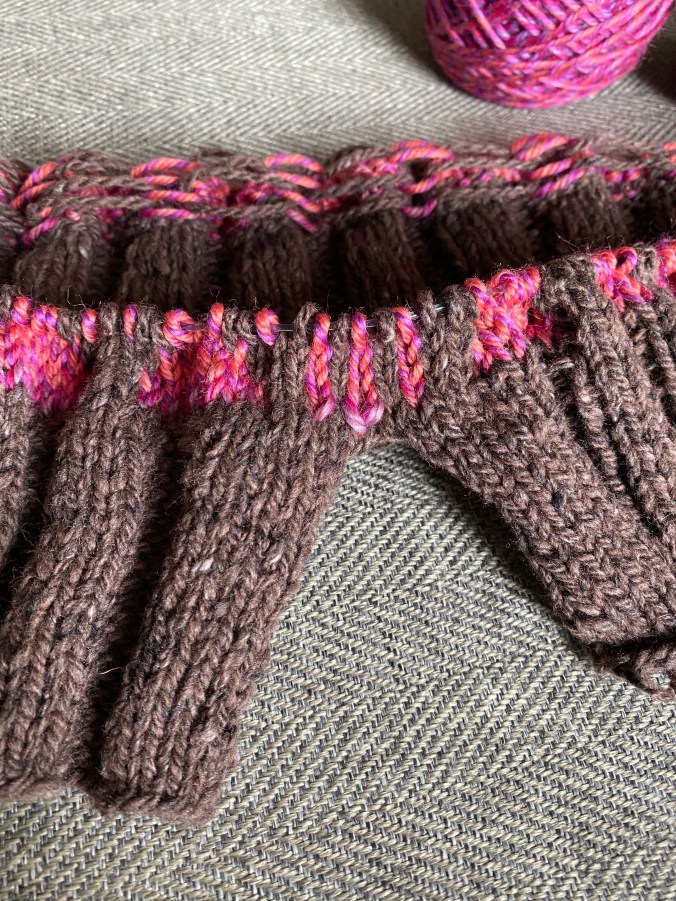
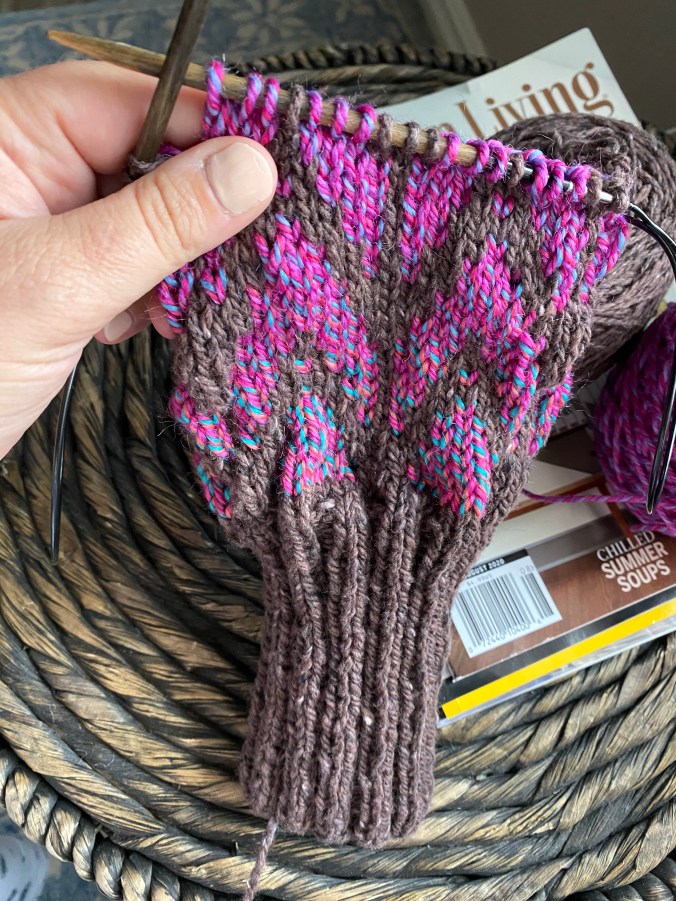
Have you started in on your belt?  If not, what are you waiting for? Grab a short needle and get cracking! Tuck that thing away in your car, or in your backpack and work on it a little here and a little there. Believe you me, you do not want to have your whole sweater done and have up to 90” of belt to work on!  And No, you probably can’t knit the whole belt while blocking your Spark Sweater.

Just do it!  I did.  It doesn’t hurt, and you will not regret it.  I promise!

F1DC3027-1BB8-4B9B-AFB4-D15DFD14677C

Sparks Flying: From the Beginning Thinking about the Finishing

I get so caught up in the excitement of starting a new project most of the time I dive right in.  About a year ago, when I was knitting my first Stonecrop sweater I was primed and ready to get knitting.  I had stash yarn that I was pairing with some recently acquired enhancement yarn. I was going to hit the ground running and couldn’t wait to A) get on an airplane for uninterrupted knitting time and B) knit the snot out of this pattern so I could wear it at an event the following week. ( you should know that I did not finish the sweater in a week like I had very unrealistically thought I could)

As I read through the pattern though I discovered something… The sweater started from the neck, knit in the round from the beginning, with the collar ribbing and was intended to be CUT!!! Cut the neck band?!? Cut through what should had been the fishing on the sweater?!? NOOOOOOO!!!

I have had the pleasure of knitting with some very skilled folks in my years in the industry, and while being only a decade into my knitting I knew this felt hinky.  My knitting group throughout time has helped me build my skills and I have learned from so many others knitting projects including the likes of @nellknits and my very own local Elizabeth Zimmerman, Sheila Pierce. These ladies showed me so many tips and tricks. They shared what they had learned along the way.  It is the invaluable lessons that come with social knitting!!!

Through those ladies I learned that to Cut your knitting is fine.  This can be done safely with toothy wool yarn that will essentially Velcro its loose fibers to its neighbors.  Use a good method for securing your raw edge and then cover it over either with ribbon or a picked up and knit band of smaller yarn and you will have a neatly finished object destined to stand the test of time.  But in my experience bands were added to pieces after the cutting.  This gives you not only the ability to remove a worn band 25 years later and apply a new one giving a treasured sweater a new life, but it keeps the raw edge away from high wear areas at the neck and waist. For years and years seamstresses would replace collars in sewn garments as well as replace cuffs if the body of the garment was worth selvaging.  Why not do the same, or have the option to do the same in knitting? It just makes sense to me.

Now what was even more confounding is that the Stonecrop, much like the Spark was a designed in a machine washable yarn.  Yarns that has been treated, even gently  are easier to care for and less likely to felt or stick to itself.  While this makes getting a beautiful fabric tension easier, it would inherently make the life of the garment shorter if  it were well worn and cut from Neck edge to Hem Edge.

Here in lies my next tip – and honestly if you do nothing else from this series except this step, I think you will be pleased.

*** Cast on your hem band, and knit the three inches flat***

In doing this you will only have to cut the color work section of the body.  You will have an open edge at the bottom of your sweater.  You can remove the 6 stitches from the stitch count that will become the steek if you so desire and cast on 6 fewer stitches at the hem.  Then using a backward loop cast on add the 6 steek stitches back before joining in the round. I opted not to do this because we will be picking up a band all the way down the edge of the sweater. I want to maintain consistency in the bulk, but I will only be using ribbon to secure my steeked edge inside the collar band.

57199671-A585-4A66-A4AC-8CCA08046D39

I have linked my Stonecrop post so you can read more about that process.  Ahh… that just feels better to me!

Sparks Flying : Sleeve tips and tricks

Knitting in the round is pretty dang fun. You don’t have to adjust or turn your work, you can pick up a pretty good speed with making your stitches, and the best part is NO PURLS!!  With color work, carrying two yarns and alternating them behind your knitting, it is important to knit in the round with consistency.

EFD589E3-DD09-4E3B-A027-726634078626

Now with small circumference knitting, like sleeves you have to be extra mindful of how your stitches are looking.  When blocked, uneven stitches in most color work even out.  The tension of the stitches sort of self balances with the float, or unused yarn that goes between worked stitches of alternating colors.   The floats are key to having nice even work.  You want to keep them loose, but not droopy.  With a smaller circumference I like to use a few extra steps to make sure this happens.

My first suggestion is to go ahead a grab double pointed needles.  Even though they can be awkward, you have a more even surface of the face or public side of your knitting.  The circular shape is less distorted on double pointed needles. This can be a big life saver and make your knitting smoother.

Second, if the thought of double pointed needles and color work makes you feel sickly then skip them!! There are no rules, you have to do what you feel comfortable with.

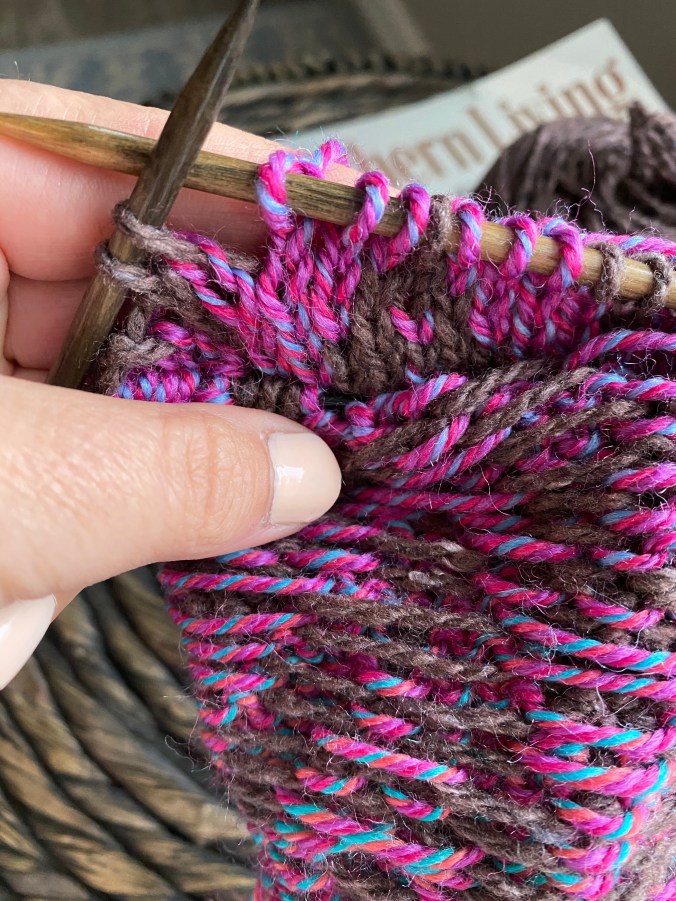
If Magic Loop is best for you, then do that. Not only will you be less likely to have a stitch escape your needle, you will feel more comfortable and that leads to looser stitches and more even tension too.  If you still feel like you are not meeting the tension or gauge you desire take one extra step: ( my third suggestion)  is to work your rounds with your sleeve turned inside out.  The face, or public side of your knitting is on the inside of your needles.  It is still the part of the work you are looking while knitting at but you are carrying your yarns around the outside of your work.  This is a minor change that can have major impact because your floats are just a smidge longer. Longer floats mean more even surface stitches!!


DD7BE271-39E6-4543-B40C-ED25E9109FAA

You can see above, with my sleeve turned inside out I am still looking at the public side of my knitting while working stitches.  They are sitting on the back needle instead of the front needle as I work. Nothing else changes.

Fourth tip for small circumference knitting and really any magic loop knitting:  Place your beginning of the round marker and them adjust where your excess cable come through your work. By changing the placement of the cable, moving it over a few stitches every couple of rounds you distribute the “disruption” of the cable and can prevent a ladder or unintended looseness in your fabric.   You can move this between pattern repeats pretty easily in color work and once you are done knitting your work will be nice and even.  I do this ALL. THE. TIME.

Lastly – and might I say as a last resort – use a different needle size than you intend to work your sweater.  The Spark pattern suggests this, but many years ago and while working on a different project that also recommended  changing needle size for a specific section of knitting  a knitting guru that I know said she hated that this suggestion was made in writing.  Her views were that knitters would take it as gospel and utilize this technique weather they needed it or not.  I though over this statement and I whole heartedly agree.

Now armed with these tricks for sleeve knitting, (Ha!) you can execute your sleeve knitting with great success!


Sparks will be Flying


Happy knitters, it has been quite a year. I have missed knitting groups, conversations and the general friendship that is synonymous with knitting.

When Andrea Mowery releases her Spark and Spice sweaters I was immediately in love. Then people started talked about it being the 2020 Rhinebeck sweater I got super excited. I love her color work designs, and I love Rhinebeck. While the festival won’t be held this year I though it would be fun to work on the sweater and add some commentary for best practices. I love working with a beautiful design and making sure I execute some additional skills for the best possible finished sweater. I hope you will join me and use this outline for success. I will be supplementing this information with posts on my blog as well as Instagram posts for near daily updates not only on progress but on the how-to part of working through this sweater.

Cheers- and let’s hear it for Copious Fibers bringing us all together!

  Follow along on Instagram: @adventurewithwhitney

First thing after printing off the pattern you will want to choose a size.   Spark is designed with 2” of positive ease so that the shawl collar band swill overlap.  There are notes saying that up to 6” would be appropriate.  I personally know that I will likely wear the sweater handing loose, at possibly consider buttons to help hold my sweater closed. I also do not want to look as though I am wearing an oversized robe. This leaves me knitting a size 46 which is more like 4” positive ease.  I am alright with that!!

Now picking yarn is the most fun, next to knitting.  I wanted to pick something similar in style to the yarns used in the design. I also wanted to pick something that would be easy to get my hands on and easy to work with. I chose my all time favorite yarn Kathmandu Aran from Queensland Collection to be my main color and Brisbane, also from Queensland Collection to by my contrast.  Brisbane changes color beautifully and is a 100% Australian wool.  It is machine washable, but in this sweater it wont be a problem even though it will be steeked.

Brisbane is a dense yarn that the company has rates a bulky.  For all of time I have not 100% agreeded on yarn ratings.  I don’t think that someone in an office should be assigning yarn weight.  Most of the time they use yardage and weight to determine the weight. While this is a helpful way to look at yarn, it is also helpful to be a knitter and be able to make a decision as to weather you like a fabric or not.

Kathmandu is a Merino, Silk and Cashmere blend that is a two ply Aran  It can stand up to anything because of the way it is spun.  When you knit it, it stays in place and will look the same on day one as day 100.  I love this, and the subtle tweed.  I like the contrast between the “rustic” quality of the tweed and the modern feeling of Brisbane.

Once your yarn is sorted out and you have enough yardage it is time to start that swatch.

Truth be told, I have knit with Brisbane and Kathmandu quite a bit.  I went ahead and just dove in on a sleeve.  If you are very familiar with the yarn you are using and have recently taken notes knowing what size needle you used, the type of needle weather metal or wood, and the gauge you achieved then I think this is a safe way to start out.

If not all those qualifications above apply to your recent knitting history, knit a gauge swatch in the pattern of the main fabric of the sweater.  That is using chart B and a working a swatch in the round, just like the sweater will be knit. I would recommend 20 or 30 +2 stitches and instead of joining your swatch in the round, knit the first and last stitch through the back of the loop. Then carry your yarn along the back of the work.  You can cut those floats and block your swatch flat and get a really good idea of how your work is going to look. Once you like your fabric and your gauge is where it should be for the pattern ( 20 sts and 22rnds =4”) then you are ready to dive into the sleeve knitting!

You are set up for the first steps of success.

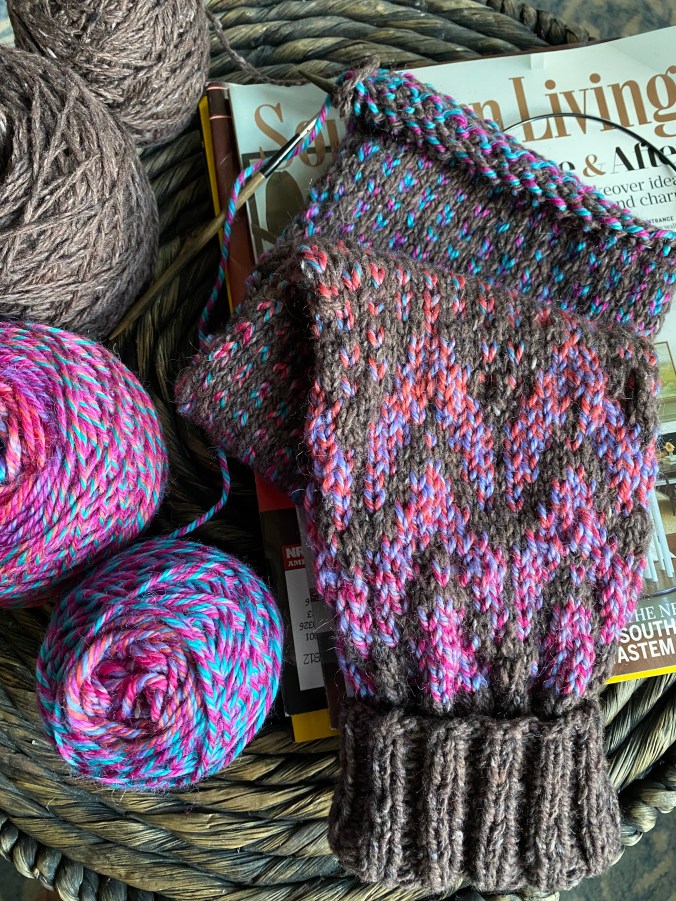
In addition to all this I strongly recommend starting to knit your belt.  If you don’t start now, you will:

A) Likely be 100% annoyed when you have only the belt to knit at the end of the sweater.

B) Opt never to knit the belt, possibly be sad that you are not able to style the sweater with said unknit belt, and perhaps not wear the sweater at all.  Now that would be a disgrace, because I know it is going to be beautiful!
 

B76C3305-9CB1-4A57-946C-1FA3F9FF0C89